Best Gifts for 4-Year-Olds: 12 Ideas by Interest and Budget
Four-year-olds want gifts they can run a story with, not gifts with more buttons. Twelve toy types that survive the year — grouped by interest, with price bands and the safety checks we apply.
How we make money: some links on this page are affiliate links. If you buy through them we may earn a commission at no extra cost to you. Our picks and rankings are not paid placements.
How we picked
- We only publish a guide when there is a real shortlist behind it. If we cannot justify a pick in one sentence, it does not go in.
- Every pick is checked against the age grading the manufacturer states and the current US recall list before it is listed.
- Prices are checked against at least two retailers. If a pick is out of stock we say so instead of quietly leaving a dead link.
- No brand can pay for a position. Commission never decides what is recommended or where it ranks.
The best gift for a four-year-old is rarely the one with the most features. At four, play has a script: the child hands out roles, repeats the same scene dozens of times, and needs props that survive being dragged from room to room. A toy that only works one way gets used twice and then lives in a cupboard.
This guide is organised the way the decision actually happens — first by what the child is into, then by what you want to spend. Every entry is a type of toy rather than one product, because stock and prices move faster than any guide can. Where a specific product does matter, the buying checks tell you what to look for in the shop.
What a four-year-old can do alone
Four is the age where a gift stops being something to hold and becomes something to do. A four-year-old can usually:
- build a tower or a simple enclosure, then knock it down on purpose;
- sort by colour and size, and count to about ten;
- hold a chunky pencil, cut with safety scissors, and glue without eating the glue;
- keep a pretend role going for ten minutes — shopkeeper, doctor, driver.
That list is the filter. If a toy needs an adult to set it up every time, or needs a screen to become fun, it will be used twice. That is the single most common reason a four-year-old’s present ends up at the back of a cupboard.
Build and make
Blocks that turn into a garage by lunchtime
Wooden building blocks, 60 pieces or more. Plain blocks beat every themed set at this age, because the same pieces become a car park, a boat and a wall in one afternoon. They are also the only toy on this list that a younger sibling can use on the same day.
Street price is usually $25–$45. What to check: sanded edges with no splinters, and pieces too big to fit through a choke tube.
Magnetic tiles that survive being stepped on
A magnetic tile set of 32–60 pieces. Tiles let a four-year-old build something that holds its shape, which blocks alone cannot do. Two triangles and two squares make a roof, and that discovery is worth the price on its own.
Street price is usually $30–$60. What to check: magnets fully enclosed inside the plastic (shake it — if it rattles, put it down), and no cracks along the seam.
A first tool set with a screwdriver that actually turns
A wooden take-apart set with real bolts. Four-year-olds are obsessed with how things are fixed. A set where the screwdriver genuinely drives a bolt teaches grip and sequence; a set with plastic moulded screws teaches nothing and strips in a week.
Street price is usually $20–$40. What to check: the tools are child-sized but not toy-flimsy, and there are no loose nuts small enough to swallow.
Washable art supplies you will not regret
Tempera paint sticks, chunky crayons and a roll of paper. Paint sticks are the quiet hero of this age: no water, no brushes, no cup to knock over, and they dry fast enough that the drawing survives the walk to the fridge.
Street price is usually $10–$25. What to check: the label says washable from fabric, not just “non-toxic”.
Pretend and role play
A shop that only needs a script
A pretend shop with play money and a till. A four-year-old will replay the same transaction fifty times. The play money is what turns a toy into a game with rules, and it quietly teaches counting and turn-taking without anyone announcing a lesson.
Street price is usually $25–$45. What to check: the till opens without batteries, and the coins are large enough to be useless to a one-year-old.
A doctor’s kit where the stethoscope works
A doctor or vet kit with a real diaphragm stethoscope. Children this age check whether the tool responds. A stethoscope that actually carries sound keeps the game going; a silent plastic disc ends it in a minute.
Street price is usually $20–$35. What to check: no real needles or syringes with detachable tips, and a case that closes.
Dress-up that is not a costume in disguise
Two or three open-ended pieces: a cape, a hat, a bag. A single-character costume only works if the child wants to be that character. A cape works for a dragon, a doctor, a superhero and a ghost, which is four games for the price of one.
Street price is usually $15–$30. What to check: no long cords around the neck, and fabric that survives a wash.
A puppet or two, because four-year-olds talk through them
Hand puppets with a movable mouth. A puppet lets a child say things they would not say as themselves, which is why shy children take to them immediately. Two puppets are better than one — the second one is the audience.
Street price is usually $12–$30 each. What to check: the mouth mechanism is stitched, not glued, and there are no button eyes.
Move and focus
A scooter with a brake they can reach
A three-wheel scooter with a rear brake. At four, the brake matters more than the deck. A child who can stop on their own gets to go further, and a rear foot brake is the only kind a four-year-old can use without thinking about it.
Street price is usually $45–$90. What to check: the brake sits under the rear wheel where the heel lands, the handlebar height adjusts, and the wheels are urethane rather than hard plastic.
A ball soft enough for indoors
A foam or soft-fill ball about 15 cm across. The gift is not the ball, it is the game that happens in a hallway on a rainy afternoon. A soft ball gets used ten times more often than a proper football, because nobody has to say “not in the house”.
Street price is usually $8–$20. What to check: the cover does not peel after a week, and it is light enough not to knock over a lamp.
Puzzles with 40 to 60 pieces, not 200
A 40–60 piece puzzle with a picture the child chose. The jump from 24 to 48 pieces is the real milestone at this age. A 200-piece puzzle bought “to grow into” stays in the box; a 48-piece puzzle gets finished, tipped out and finished again.
Street price is usually $12–$25. What to check: thick board that does not bend, and pieces that stay apart in the box.
A game with one rule
A first board or card game with a single rule. Four-year-olds can hold one rule in their head, not four. Games where everyone does the same thing on every turn — roll, move, pass — are the ones that get played without an adult supervising the rules.
Street price is usually $12–$25. What to check: a game round takes under ten minutes, and losing does not eliminate a player from the rest of the game.
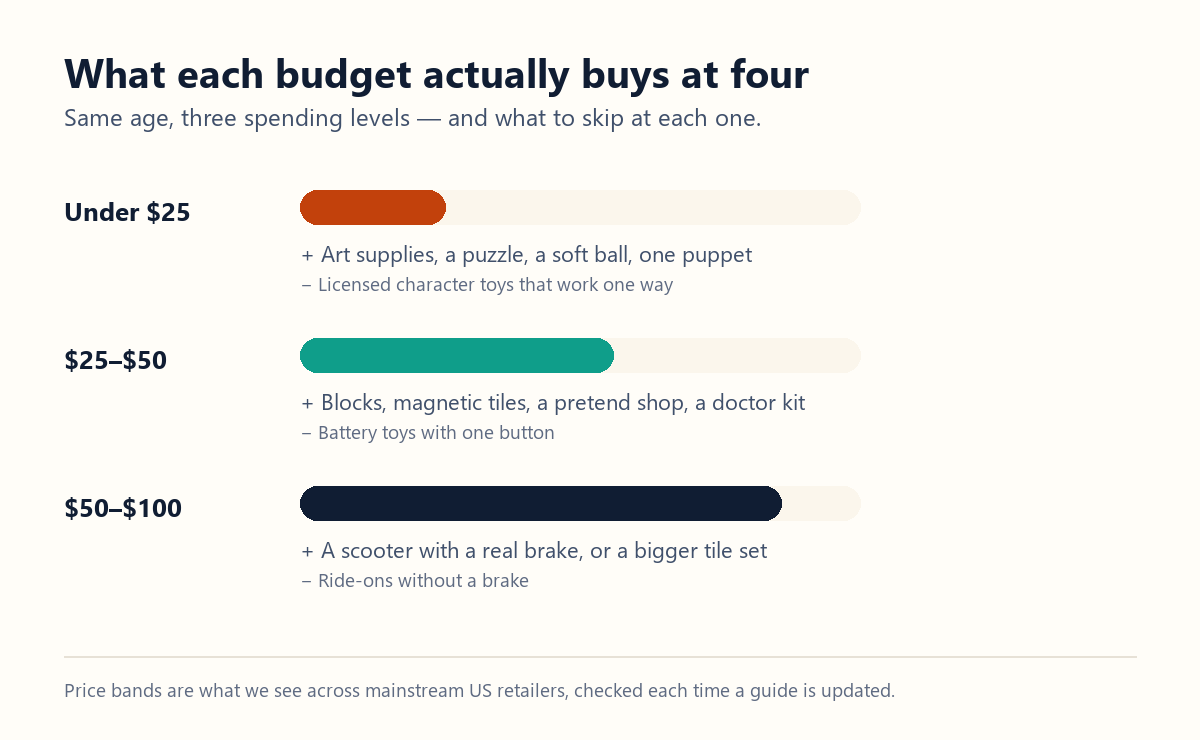
What each budget actually buys
| Budget | What it buys at this age | What to skip |
|---|---|---|
| Under $25 | Art supplies, a puzzle, a soft ball, one puppet, a card game | Licensed character toys that only work one way |
| $25–$50 | Building blocks, magnetic tiles, a pretend shop, a doctor kit | Battery-heavy toys with one button and one song |
| $50–$100 | A scooter with a real brake, or a larger tile set that grows with them | Ride-ons without a brake, and anything that needs a screen to work |
The safety checks we apply
Every pick on this page has to pass the same short list before it is listed. The same list works in a shop, with the box in your hand:
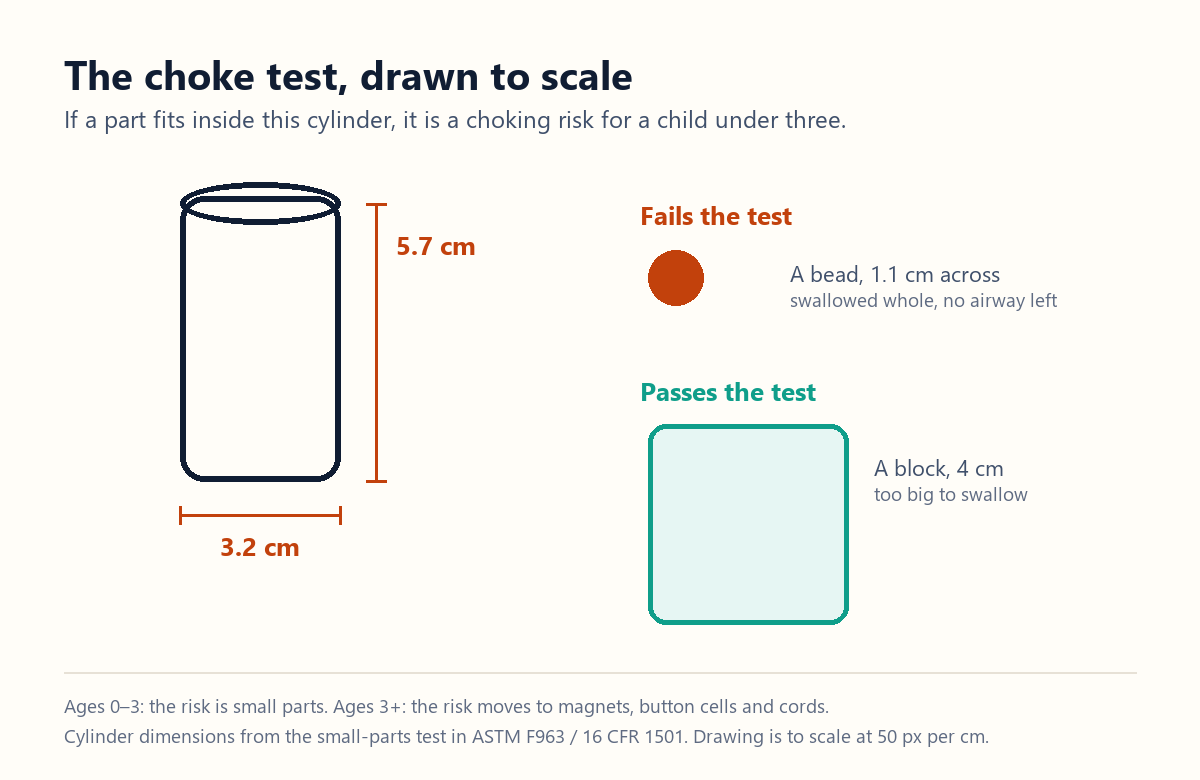
- Age grading on the box, not on the website. A toy sold for “3+” has been assessed for small parts. If the listing does not state a grading, treat it as unsuitable for a four-year-old.
- No loose small parts. Buttons, beads and detachable eyes are the classic choking risk at this age, and they are usually the first thing to fall off.
- Batteries behind a screwed cover. A sliding plastic door is not enough — button cells are the one item on this list that can cause serious injury within minutes.
- Recall check before you buy. A toy can be on a recall list years after launch. We check the model against current recalls each time a guide is updated.
- No long cords, straps or drawstrings around the neck, on dress-up and on ride-ons alike.
- Check for recalls before you buy, new or second-hand. The CPSC recall database is searchable by brand and model, and toys are recalled years after launch.
- Toy safety testing has a standard behind it. The age grading and small-parts rules come from ASTM F963, which is what the 3+ label actually refers to.
Questions parents ask
Is a four-year-old too young for Lego?
For standard Lego, usually yes — the small pieces are graded 4+ only in the larger sets, and most four-year-olds cannot yet press the bricks together hard enough to keep a model intact. Duplo-style large bricks are the better fit at this age, and they still work with the standard bricks later.
How many presents is too many?
The useful limit is not a number, it is attention. A four-year-old can properly engage with one new toy at a time; beyond three or four in one sitting, the later ones get opened and set aside. If several people are buying, fewer and larger usually beats many and small.
Are electronic toys worth it at this age?
Sometimes, but not as the main present. A toy that talks at the child does the playing for them. The ones that hold up are the ones where the electronics support a game the child is already running — a till that beeps, a torch that works — rather than a device that only has one mode.
Looking for a different age? The age index covers every band from one to twelve. For how picks are made and how this site earns money, see how we choose gifts.