Best Gifts for 1-Year-Olds: 8 Ideas That Survive the Mouthing Stage
A one-year-old tests everything with their mouth and their whole body. Eight gifts that hold up to both, with the safety checks that actually matter at this age.
How we make money: some links on this page are affiliate links. If you buy through them we may earn a commission at no extra cost to you. Our picks and rankings are not paid placements.
How we picked
- We only publish a guide when there is a real shortlist behind it. If we cannot justify a pick in one sentence, it does not go in.
- Every pick is checked against the age grading the manufacturer states and the current US recall list before it is listed.
- Prices are checked against at least two retailers. If a pick is out of stock we say so instead of quietly leaving a dead link.
- No brand can pay for a position. Commission never decides what is recommended or where it ranks.
A one-year-old does not play with a toy so much as interrogate it: into the mouth, off the table, under the sofa, back into the mouth. Anything that cannot survive that sequence is not a gift, it is a week of use followed by a cupboard.
So this list is short and unglamorous. Every entry is a type of toy rather than a brand, because what makes these work at twelve months is a physical property — size, weight, edges — not a licence or a light show.
What a one-year-old can do alone
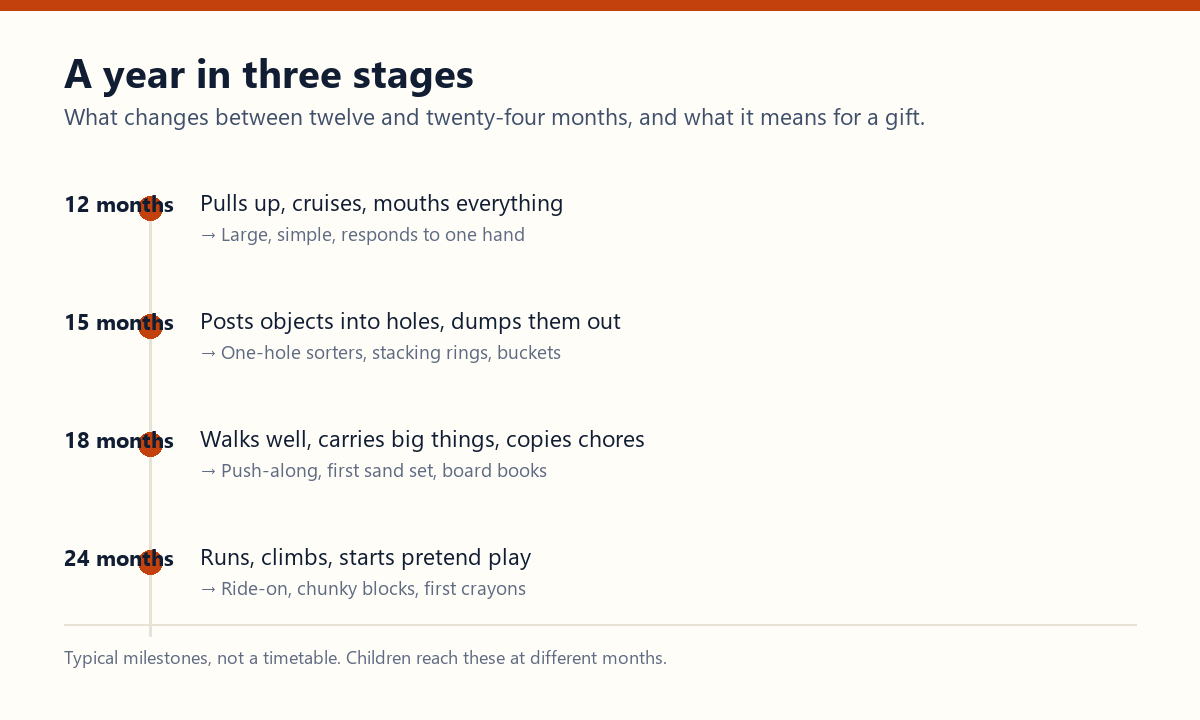
At twelve to twenty-four months, a child is usually working on:
- pulling up to stand and cruising along furniture;
- putting things into containers and taking them out again, over and over;
- understanding cause and effect — press, and something happens;
- mouthing almost everything, because the mouth is still a main sensory organ.
That list explains why the best gifts at this age are large, simple and responsive. A toy that needs a demonstration will be ignored; a toy that reacts to a one-year-old’s own hand will be used fifty times in an afternoon.
Stack, fill and dump
A stacker that survives being chewed
Chunky wooden stacking rings, three or more. The rings are big enough to grab with a whole fist and the post is short, so the tower goes up without a lesson. This is the toy that teaches size order without anyone teaching size order.
Street price is usually $15–$30. What to check: rings at least 5 cm across, painted with a water-based finish, post rounded and no taller than the base is wide
A shape sorter with one hole, not six
A single-shape sorter or posting box. Six-hole sorters are a two-year-old’s puzzle. At one, one hole and one shape is the whole game: post it, lift the lid, do it again.
Street price is usually $15–$30. What to check: the lid opens easily with small hands, and no piece is small enough to fit through a choke tube
A bucket of things that pour
A first sand-and-water set, five pieces or fewer. Pouring is the single most repeated activity of the second year. Outdoors it is a sandpit; indoors it is a dry box of lentils and a towel.
Street price is usually $10–$20. What to check: no narrow tubes that trap water and grow mould, and no metal parts that rust
Move and chase
A ball they can crawl after
A soft sensory ball about 15 cm across. A ball is the only toy that gets a one-year-old moving without being asked. Soft and light means it can be thrown indoors without a conversation about the lamp.
Street price is usually $8–$20. What to check: the cover does not peel, and it is light enough that a thrown ball cannot knock anything over
A push-along that does not run away
A weighted push toy with no wheels, or very stiff wheels. Most push toys shoot forward the moment a toddler leans on them, and the child falls. A weighted base turns it into a support instead of a runaway.
Street price is usually $25–$50. What to check: the handle is at chest height for a standing toddler, and the base does not tip when the child pulls down on it
A low climber for pulling up
A foam or wooden step-and-slope set. This is furniture as much as toy: it gives a cruising child something legal to climb instead of the sofa. It also survives being used as a garage later.
Street price is usually $60–$120. What to check: no gaps a limb can wedge into, a non-slip base, and a height the child can get down from without help
Quiet and soothe
A teether that can go in the fridge
Two silicone teethers, one smooth and one textured. Cold helps more than anything else during a teething week, so the teether has to be fridge-safe and hand-sized. Two means one is always clean.
Street price is usually $8–$18. What to check: one-piece silicone with no liquid inside, no string or clip attached, and dishwasher-safe on the top rack
A drum that will not be hated
A hand drum or a small shaker set. A one-year-old is discovering that their hand causes a sound. A drum gives that discovery a home; the alternative is a saucepan and a spoon at 6am.
Street price is usually $12–$28. What to check: a skin or membrane that can be re-tightened, and a volume that stays under a shout
What each budget actually buys
| Budget | What it buys at this age | What to skip |
|---|---|---|
| Under $20 | A soft ball, a teether, a posting box, a shaker | Anything battery-powered with one button and one song |
| $20–$50 | A stacking set, a push-along, a first sand set | Walkers with wheels — paediatricians advise against them |
| $50–$120 | An indoor climber, or a sturdy push wagon | Ride-ons the child cannot get off independently |
The safety checks we apply
At this age the safety list is shorter than for older children, and far less forgiving. The same list works in a shop:
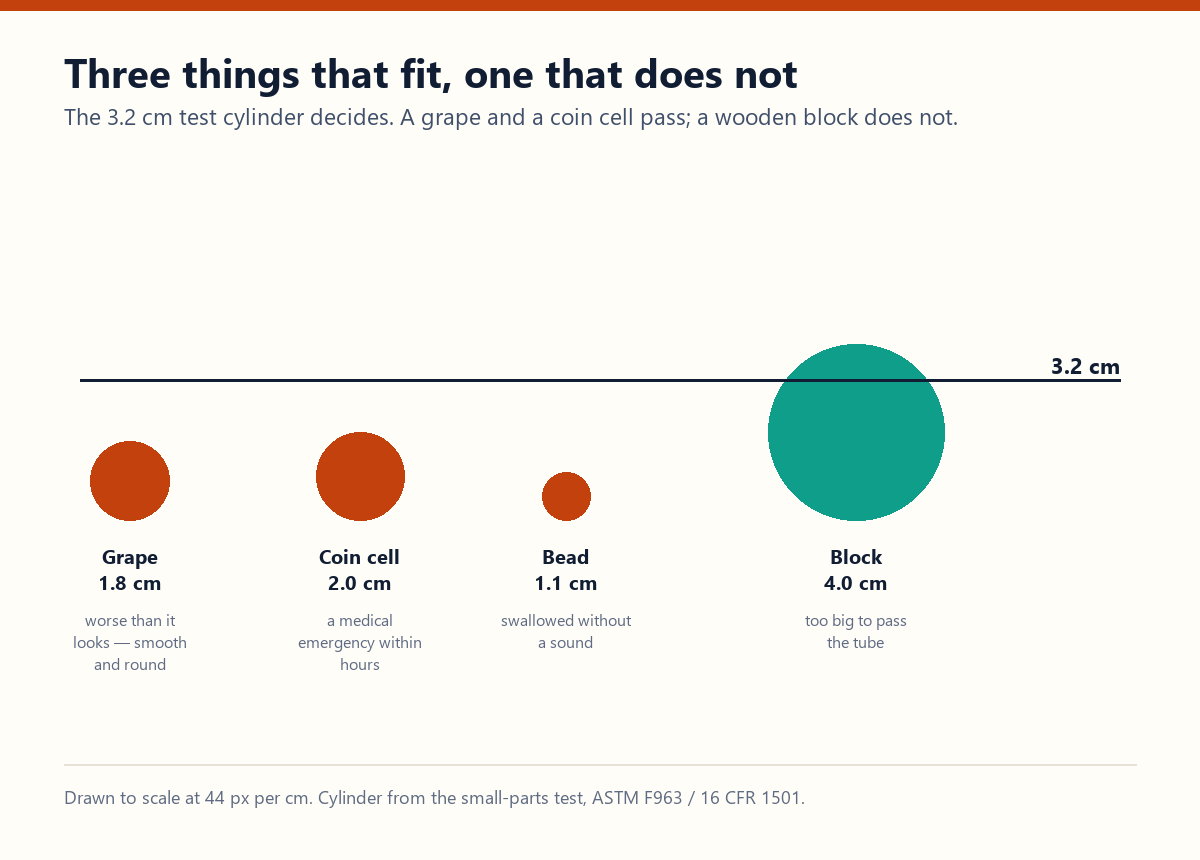
- Nothing that fits through a choke tube. Roughly, if it passes a 3.2 cm opening it is too small for a one-year-old.
- No button batteries, anywhere. A coin cell swallowed at this age is a medical emergency within hours; check that every battery compartment is closed with a screw.
- No cords, straps or loops long enough to go around a neck — including teether clips and dummy chains.
- Skip the baby walker. The American Academy of Pediatrics advises against infant walkers because of injury data; the AAP’s baby safety guidance covers the alternatives.
- Check for recalls before you buy second-hand. The CPSC recall database is searchable by product name, and toys are recalled years after launch. Toy safety testing itself follows ASTM F963.
Questions parents ask
Is a one-year-old too young for crayons?
Not too young, but expect two minutes of drawing and ten minutes of putting them back in the box. Fat, washable crayons are the version that survives; thin ones snap under a one-year-old’s grip.
How many gifts is too many at a first birthday?
The practical limit is attention, not count. A one-year-old can engage with one new object at a time, so a small pile of large, simple things gets more use than a large pile of small ones.
Do I need to buy educational toys?
No. At this age the educational content is the physics — stacking, posting, pouring, dropping. Toys marketed as teaching letters are usually teaching the parent.
Shopping for a different age? The age index covers every band from one to twelve. For how picks are made and how this site earns money, see how we choose gifts.