Best Gifts for 2-Year-Olds: 8 Ideas for a Child Who Says No to Everything
Two-year-olds are not difficult, they are busy proving they can decide things. Eight gifts that fit that agenda, plus the safety checks that matter at this age.
How we make money: some links on this page are affiliate links. If you buy through them we may earn a commission at no extra cost to you. Our picks and rankings are not paid placements.
How we picked
- We only publish a guide when there is a real shortlist behind it. If we cannot justify a pick in one sentence, it does not go in.
- Every pick is checked against the age grading the manufacturer states and the current US recall list before it is listed.
- Prices are checked against at least two retailers. If a pick is out of stock we say so instead of quietly leaving a dead link.
- No brand can pay for a position. Commission never decides what is recommended or where it ranks.
The thing that changes at two is not coordination, it is intention. A two-year-old wants to do the pouring, choose the colour, push the button and close the door themselves — and will reject help even when help is faster.
So the gifts that work are the ones that let a child be the one in charge, with a design that makes success likely. Every entry below is a type rather than a brand, because at this age the mechanism matters more than the label.
What a two-year-old can do alone
Between two and three, most children can:
- carry something big while walking, and stop on purpose;
- fill and empty a container, and line objects up in a row;
- start a pretend sequence — feed the doll, put the doll to bed;
- follow one instruction, then ignore the second one entirely.
That is why the best gifts look open-ended but are physically forgiving: big pieces, few rules, and a clear ‘I did it’ moment at the end.
Build and knock down
Blocks big enough to build a door
Cardboard or foam building blocks, 20 pieces or more. A two-year-old wants to build something taller than themselves, which means blocks measured in centimetres, not millimetres. They also fall over safely, which is half the game.
Street price is usually $25–$50. What to check: each block is at least 10 cm on a side, edges are taped or sealed, and a stack of five does not slide on a wooden floor
A floor puzzle with 4 to 8 pieces
A chunky first puzzle with matching pictures underneath. Piece count is not the point at two; the win is a puzzle the child can finish alone. Eight pieces is a two-minute job, which is exactly the right length.
Street price is usually $12–$25. What to check: the picture is printed under the pieces as a guide, and the board is thick enough that pieces do not bend
A shape sorter with six holes, now
A classic six-shape sorter with a lid. This is the upgrade from the one-hole version: six shapes, one lid, and a satisfying clunk. It teaches trial and error without a screen narrating it.
Street price is usually $15–$30. What to check: the shapes are chunky, the lid lifts easily, and no shape is small enough to be a choke risk
Pretend and copy
A doll or truck that gets dragged everywhere
One sturdy doll or vehicle, soft body, hard head. At two, a toy becomes a companion: it goes to the shop, it gets put to bed, it gets blamed. One well-made version beats five that fall apart by spring.
Street price is usually $20–$45. What to check: no loose eyes or buttons, and fabric that survives a 40-degree wash
A set of toy kitchen basics
Five or six pieces: pot, pan, spoon, two plates, one play food. A two-year-old does not need a play kitchen to cook; a pot and a spoon on the floor is the same game. Fewer, better pieces get used more than a full plastic kitchen.
Street price is usually $15–$35. What to check: no sharp edges on the pan handles, and paint that does not flake at the rim
A lift-the-flap book with thick flaps
Two board books with card flaps. The flap is the toy: open, close, open, close. It teaches book handling before reading, and it survives being sat on if the board is thick enough.
Street price is usually $10–$20. What to check: flaps are card, not paper, and the book has rounded corners
Move and make noise
A ride-on they push with their feet
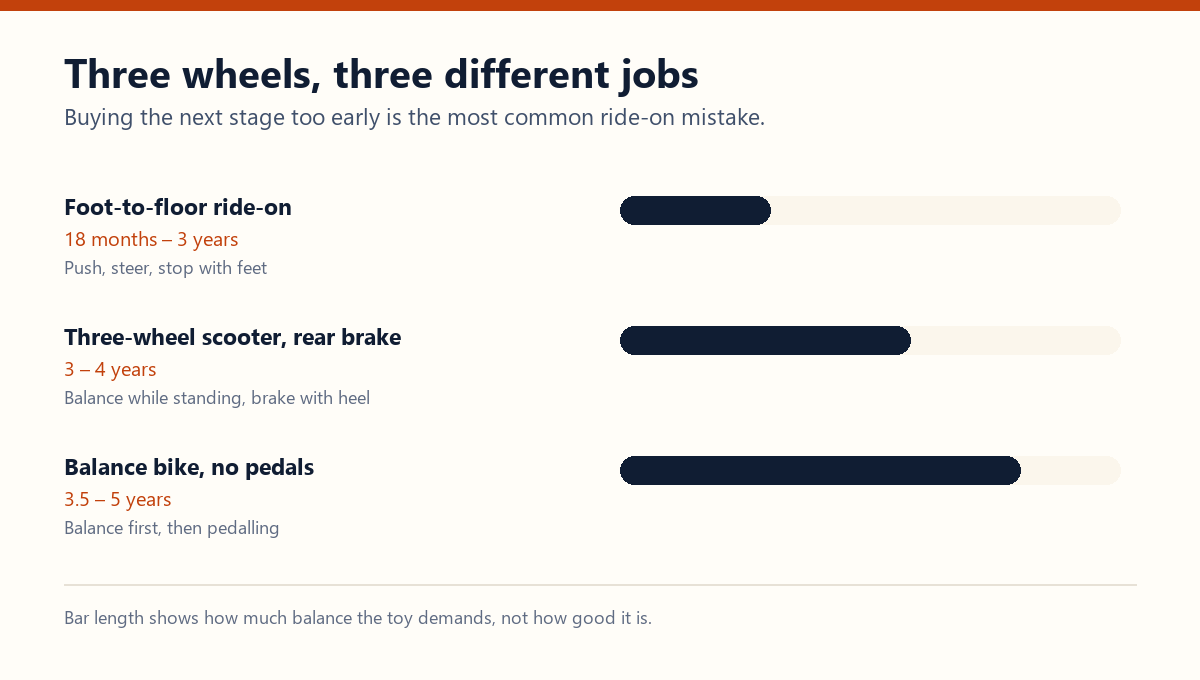
A foot-to-floor ride-on with a wide wheelbase. This is the bridge to a scooter: no pedals, no balance required, and the child’s own feet are the brake. A wide base means it does not tip when they turn too sharply.
Street price is usually $30–$70. What to check: a steering limit so it cannot jack-knife, no exposed pinch points at the wheels, and a seat height the child can straddle
Fat crayons and a roll of paper
Washable jumbo crayons plus a paper roll. Two-year-olds grip with a fist, so thin crayons snap in the first minute. Jumbo crayons survive the fist and the drop.
Street price is usually $10–$25. What to check: the label says washable from fabric, not just non-toxic
A ball big enough to kick
A soft football or playground ball, 20 cm across. Kicking needs a target that does not roll into the road. A slightly over-sized soft ball is easier to connect with than a small hard one.
Street price is usually $10–$25. What to check: the surface grips a wooden floor instead of sliding, and it is soft enough for indoor use
What each budget actually buys
| Budget | What it buys at this age | What to skip |
|---|---|---|
| Under $25 | Crayons and paper, a puzzle, a board book, a soft ball | Small figures and anything with tiny accessories |
| $25–$50 | Big blocks, a doll or truck, kitchen basics | Battery toys where the toy does the playing |
| $50–$70 | A foot-to-floor ride-on | Pedal trikes — the child cannot reach the pedals yet |
The safety checks we apply
Two-year-olds are faster and stronger than they look, and still mouth small objects. The checks we apply:
- Still no small parts. The choke risk does not end at two; it ends somewhere around three, and only for children who have stopped mouthing.
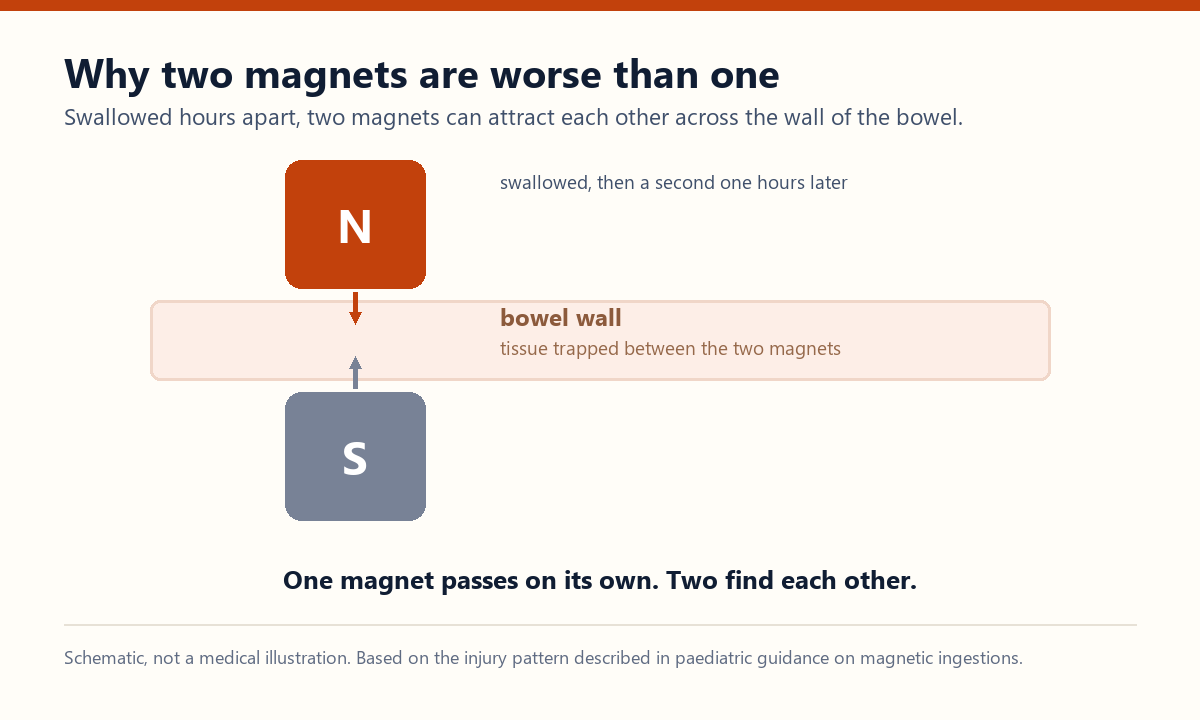
- No small magnets. Two or more swallowed magnets can attract each other through bowel wall — this is the injury that makes magnetic toys a separate category of risk.
- Ride-ons need a wide base and a steering limit, and should be used away from stairs and driveway slopes.
- Anchor the furniture they climb. At this age the injury risk moves from the toy to the room; the AAP’s toddler safety guidance covers anchoring and stairs.
- Search any second-hand toy for recalls in the CPSC database before it comes into the house.
Questions parents ask
Is a two-year-old ready for a balance bike?
Usually not until two and a half to three. Before that, a foot-to-floor ride-on gives the same push-and-glide practice with a lower seat and no balance requirement.
Should I buy a tablet for a two-year-old?
The guidance from paediatric bodies is to prioritise interactive play and shared screen use over solo device time at this age. A toy that reacts to the child beats a screen that performs at them.
What if the child ignores the gift?
Give it two weeks on a shelf and bring it out again. Two-year-olds reject things they cannot yet do; the same toy often lands three weeks later.
Shopping for a different age? The age index covers every band from one to twelve. For how picks are made and how this site earns money, see how we choose gifts.