Best Gifts for 5-Year-Olds: 8 Ideas for the Year Rules Start to Matter
Five-year-olds want to follow instructions, win games and read the box themselves. Eight gifts that meet them there, with the safety checks for this age.
How we make money: some links on this page are affiliate links. If you buy through them we may earn a commission at no extra cost to you. Our picks and rankings are not paid placements.
How we picked
- We only publish a guide when there is a real shortlist behind it. If we cannot justify a pick in one sentence, it does not go in.
- Every pick is checked against the age grading the manufacturer states and the current US recall list before it is listed.
- Prices are checked against at least two retailers. If a pick is out of stock we say so instead of quietly leaving a dead link.
- No brand can pay for a position. Commission never decides what is recommended or where it ranks.
Five is the year children start wanting the rules. They want the instructions, the score, the chart, the badge — and they want to be the one who reads it out. A gift that ignores that shift feels babyish within a month.
Every entry is a type of toy rather than a brand. At this age the deciding factor is usually whether the child can run it without an adult translating.
What a five-year-old can do alone
At five, most children can:
- follow a picture instruction sequence with three or four steps;
- play a game with rules and accept losing, sometimes;
- write their own name and sound out simple words;
- ride a scooter or balance bike with confidence, and stop on request.
That combination — instructions, rules, reading — is why the best gifts at five look like real equipment rather than toys. The child is practising being competent.
Build something that takes two sittings
A building set with instructions they can follow alone
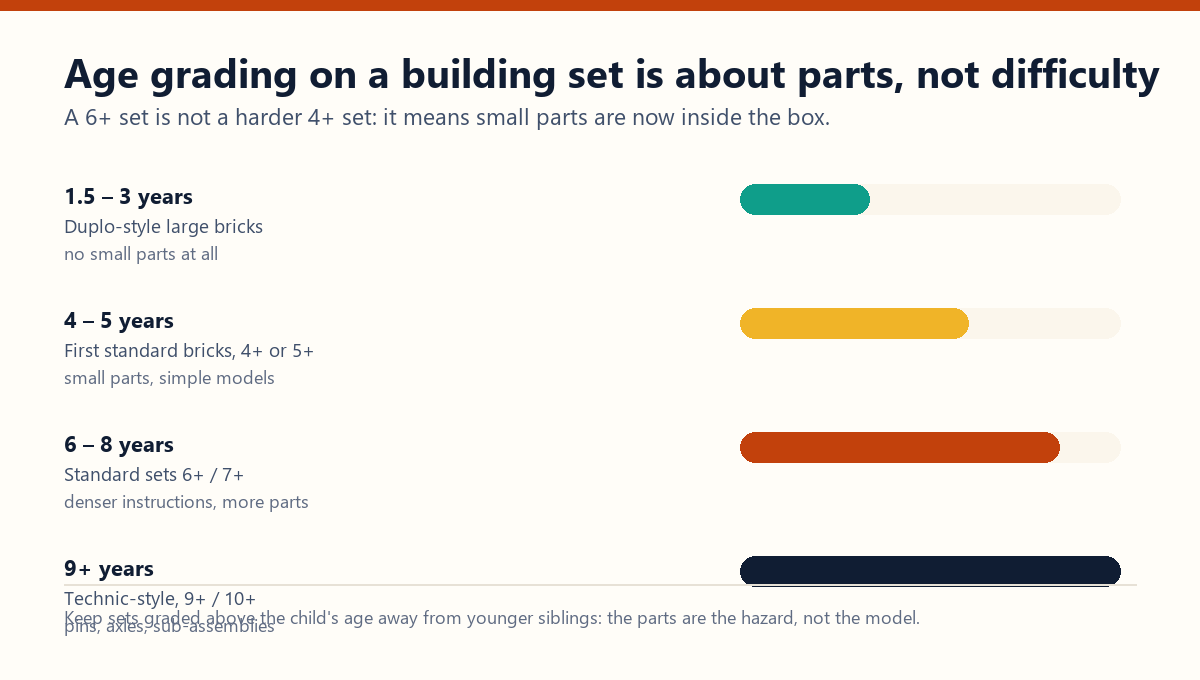
A 100–300 piece set graded 5+ or 6+. Five-year-olds can follow a picture sequence, which means the instruction booklet becomes the toy. Start with a set the child can finish in one sitting, or the project dies on the table.
Street price is usually $30–$70. What to check: the box states 5+ or 6+, the pieces are in numbered bags, and the model is not so large it needs an adult for step one
A marble run with a stable base
A wooden or plastic marble run, 60+ pieces. A marble run is engineering with an instant reward: you can see whether your idea worked. The base is what separates a good set from a frustrating one.
Street price is usually $30–$60. What to check: the base is wide enough not to tip, and the marbles are glass-free (plastic or wood) if there is a younger sibling
Craft tools that are real, not pretend
Child scissors, a hole punch, glue sticks and a box of offcuts. At five the tool matters more than the kit: scissors that cut, a punch that punches. This is the age where a child can be trusted with real tools and will use them weekly.
Street price is usually $15–$35. What to check: scissors are blunt-tipped and fit a five-year-old’s hand, and the punch does not need adult strength
Play something with a score
A game where the whole family can lose
A family board or card game for 2–5 players, 15–20 minutes. Five-year-olds can hold a rule and a goal at the same time. The game that gets played is the one that finishes before attention does.
Street price is usually $15–$35. What to check: a round is under 20 minutes, luck plays a real part, and no player is eliminated early
A card game with bluffing
A simple bluffing or matching card game. Bluffing is a five-year-old’s newest social skill, and a card game is the safest place to practise it. It also teaches reading the other player, which no screen does.
Street price is usually $10–$20. What to check: the rules fit on one card, and the deck survives being shuffled by a child
A first chapter-book series
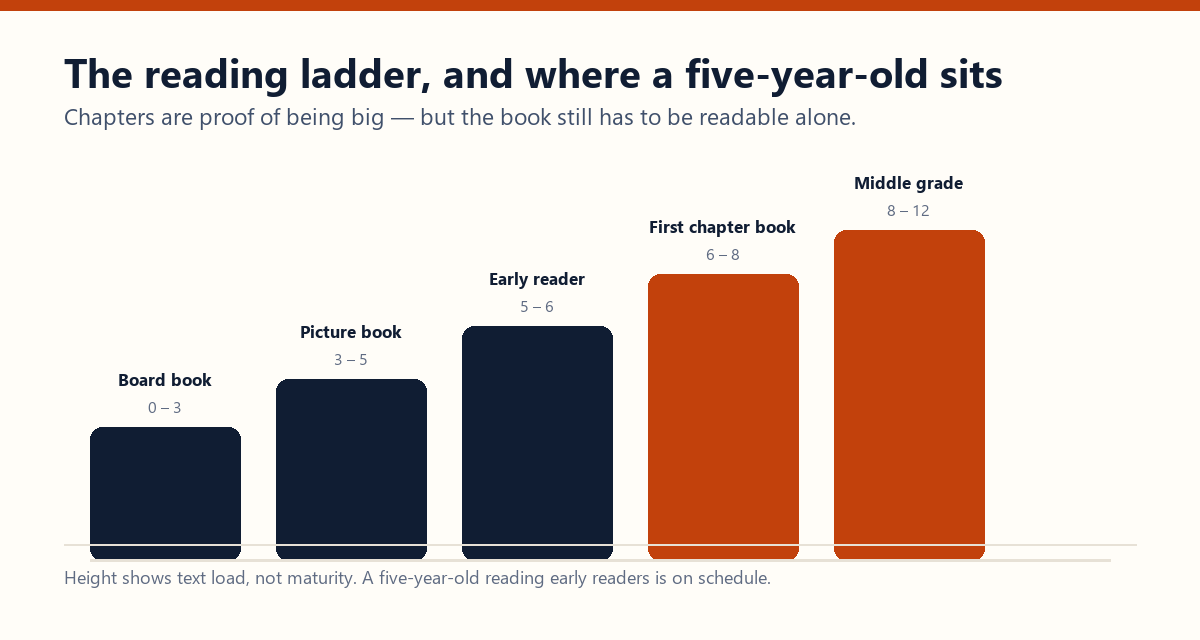
Two early-reader chapter books at the child’s reading level. A five-year-old who can sound out words wants a book with chapters, because chapters are proof of being big. Buy two: the second one is the reward.
Street price is usually $10–$20. What to check: large type, a picture on every spread, and a story the child can retell
Move and collect
A scooter with a brake they can reach
A two- or three-wheel scooter with a rear foot brake. Five is when speed becomes interesting, which makes the brake the safety feature that matters. Check the reach with the child standing on the deck.
Street price is usually $50–$100. What to check: the brake sits under the heel, the bar adjusts, and the wheels are urethane rather than hard plastic
Something to collect and sort
A hand lens, a small case and a notebook. Five-year-olds sort obsessively — stones, leaves, bottle caps. Giving the collection a case and a notebook turns a habit into a project.
Street price is usually $10–$25. What to check: the lens is glass-free or has a rim, and the case closes with a child-strength latch
What each budget actually buys
| Budget | What it buys at this age | What to skip |
|---|---|---|
| Under $25 | Craft tools, a card game, two early readers, a hand lens | Large sets the child cannot finish without help |
| $25–$70 | A 100–300 piece building set, a marble run, a family game | Battery toys that play instead of the child |
| $50–$100 | A scooter with a real brake, or a balance bike if they have outgrown theirs | Bikes sized for a seven-year-old ‘to grow into’ |
The safety checks we apply
Five-year-olds are fast, and they trust instructions. Both matter for what you buy:
- Helmet for wheels, every time. A scooter at five moves fast enough to need one; fit it flat, strap under the chin, no tilt back on the head.
- Check the age grading against the piece count. Sets graded 6+ usually contain parts a five-year-old will still put in their mouth.
- Magnets and button cells remain the two items to refuse. Both cause injuries that are severe and fast.
- Search the brand before buying second-hand. The CPSC recall database is the authoritative list; toy safety testing follows ASTM F963.
- Play equipment and helmet guidance is covered in the AAP’s school-age guidance.
Questions parents ask
Is five too young for standard Lego?
For most five-year-olds, a set graded 4+ or 5+ is the right entry point; the classic 6+ sets contain small parts and denser instructions. Start with a set they can finish in one sitting, then size up.
Balance bike or pedal bike at five?
If they have not used a balance bike, start there for a few months — it teaches balance before pedalling, which is the order that works. Most children move to pedals without training wheels after that.
How much screen time is reasonable at five?
Paediatric guidance for this age favours a consistent limit plus co-viewing over a strict number. The practical rule: screens do not replace the physical play that this age needs.
Shopping for a different age? The age index covers every band from one to twelve. For how picks are made and how this site earns money, see how we choose gifts.