Art Supplies for Kids: What to Buy at Each Age
The right art supply is the one a child can open, use and close without an adult. Here is what changes between two and ten, and what is a waste of money at every age.
How we make money: some links on this page are affiliate links. If you buy through them we may earn a commission at no extra cost to you. Our picks and rankings are not paid placements.
How we picked
- We only publish a guide when there is a real shortlist behind it. If we cannot justify a pick in one sentence, it does not go in.
- Every pick is checked against the age grading the manufacturer states and the current US recall list before it is listed.
- Prices are checked against at least two retailers. If a pick is out of stock we say so instead of quietly leaving a dead link.
- No brand can pay for a position. Commission never decides what is recommended or where it ranks.
Art supplies fail for a boring reason: the child cannot operate them alone. A paint set that needs water, a brush and a cup is a supervised activity; a paint stick is a thing a four-year-old can do at the kitchen table while you cook.
So this guide is organised by independence, not by ambition. Every entry answers one question: can the child get it out, use it and put it away without help?
Four things that decide whether it gets used
Price and brand matter far less than these:
- Can they open it? A cap a five-year-old cannot twist means the set stays in the cupboard.
- Does it need a setup? Water, brushes and a mixing palette turn a five-minute activity into a twenty-minute one.
- Does it survive being dropped? Glass jars and thin plastic palettes do not.
- Is it washable from fabric, not just labelled non-toxic? That is the difference between a shirt and a rag.
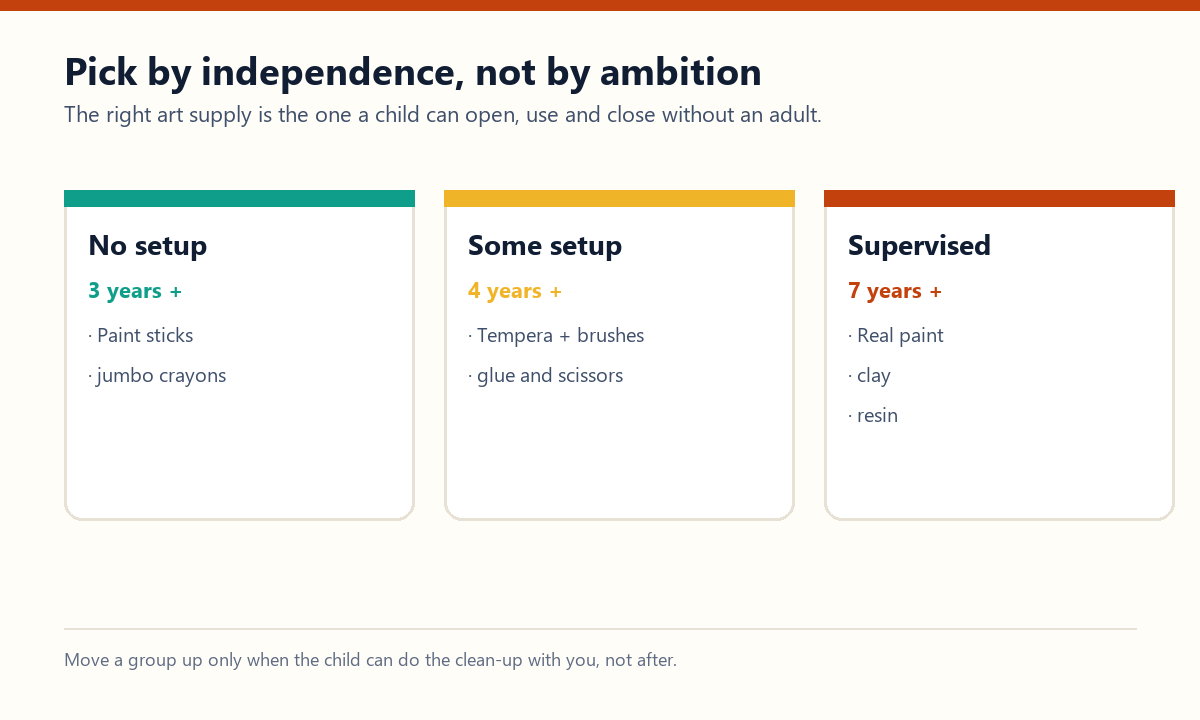
What to buy, by how much mess you can tolerate
The groups run from ‘no clean-up’ to ‘put a sheet down first’. Pick the highest group you can live with.
No water, no brushes, no cup
Tempera paint sticks, a dozen colours. Paint sticks are the single best art purchase for a three- to six-year-old: real paint, dries in seconds, no setup, and a cap a child can manage.
Street price is usually $12–$25. What to check: the label says washable from fabric, and the cap twists without tools
The drawing that survives the walk to the fridge
Jumbo crayons and a paper roll. A roll beats a pad, because the size of the paper is what stops a child drawing tiny. Jumbo crayons survive a fist grip; thin ones snap in the first minute.
Street price is usually $10–$25. What to check: the roll is at least 30 cm wide and the crayons are labelled washable
The first real paint, with supervision
Washable tempera in three primary colours. Three colours plus white teach mixing better than a twelve-colour set, because the child has to make the in-between colours themselves.
Street price is usually $15–$30. What to check: the jars have wide lids, and the paint is labelled washable from clothing
Cutting, sticking, and the fine-motor jump
Blunt-tipped scissors, glue sticks and a box of offcuts. At four and five the tool matters more than the kit. Scissors that actually cut teach grip; safety scissors that only crease paper teach nothing.
Street price is usually $10–$25. What to check: the scissors fit a child’s hand and cut paper in one movement
The age where technique appears
A proper sketchbook and two grades of pencil. Between seven and ten, children start wanting to draw something specific. A sketchbook and a 2B pencil give them the tool; felt tips give them a colouring book.
Street price is usually $10–$25. What to check: the paper is thick enough for erasing without going fuzzy
What to skip at every age
Giant 150-piece art kits. They contain one of everything and nothing that works. The markers dry out, the paint is thin, and the box becomes storage for the two items the child actually uses.
Street price is usually —. What to check: if a kit has more than 40 pieces for under $25, most of them are filler
What each budget actually buys
| Budget | What it buys | What to skip |
|---|---|---|
| Under $25 | Paint sticks, jumbo crayons, a paper roll | 150-piece kits with thin markers |
| $25–$50 | Tempera in three colours, decent scissors and glue | Sets that need water and brushes to work |
| $50–$100 | An easel, or a proper sketchbook and pencil set | Studio-grade materials for a child under eight |
The safety checks we apply
Art supplies are the category where ‘non-toxic’ is doing real work, because the material ends up in mouths and on skin:
- Look for a non-toxic statement on the label, not just ‘child-safe’. Paints and clays sold for children are covered by toy safety rules; adult art materials are not.
- Age grading matters for small parts: beads, pom-poms and googly eyes are choking hazards under three.
- Ventilate for anything solvent-based. Markers, glues and resin kits aimed at older children carry ventilation instructions for a reason.
- Check recalls for craft kits in the CPSC database; art materials sold as toys fall under ASTM F963.
Questions parents ask
Are cheap crayons fine?
For wax crayons, mostly yes — the difference is how much wax flakes and how hard they are to colour with. The gap is much bigger with markers and paint, where cheap versions dry out or go translucent.
When can a child use real paint?
Around three, with washable tempera and a sheet down. The limiting factor is not the paint, it is whether the child can stop at the edge of the paper.
Do we need an easel?
Not until about six. Before that, paper on the floor or table gets used more, because the child can move around it.
More by interest: the interest index groups every guide the same way. Shopping by age instead? Start at gifts by age. For how picks are made and how this site earns money, see how we choose gifts.