Magnetic Tiles for Kids: How Many Pieces, and What to Check
Set size matters more than brand: 32 tiles builds flat shapes, 60 builds a house, 100 builds something tall. Here is how to choose, and the two safety checks that decide it.
How we make money: some links on this page are affiliate links. If you buy through them we may earn a commission at no extra cost to you. Our picks and rankings are not paid placements.
How we picked
- We only publish a guide when there is a real shortlist behind it. If we cannot justify a pick in one sentence, it does not go in.
- Every pick is checked against the age grading the manufacturer states and the current US recall list before it is listed.
- Prices are checked against at least two retailers. If a pick is out of stock we say so instead of quietly leaving a dead link.
- No brand can pay for a position. Commission never decides what is recommended or where it ranks.
Magnetic tiles are the one building toy that survives the transition from toddler to primary school, because the same pieces work at every level: a two-year-old stacks them, a five-year-old builds a house, an eight-year-old builds a bridge that holds weight.
The buying decision is almost entirely about piece count and magnet quality. Both are checkable in the shop in under a minute.
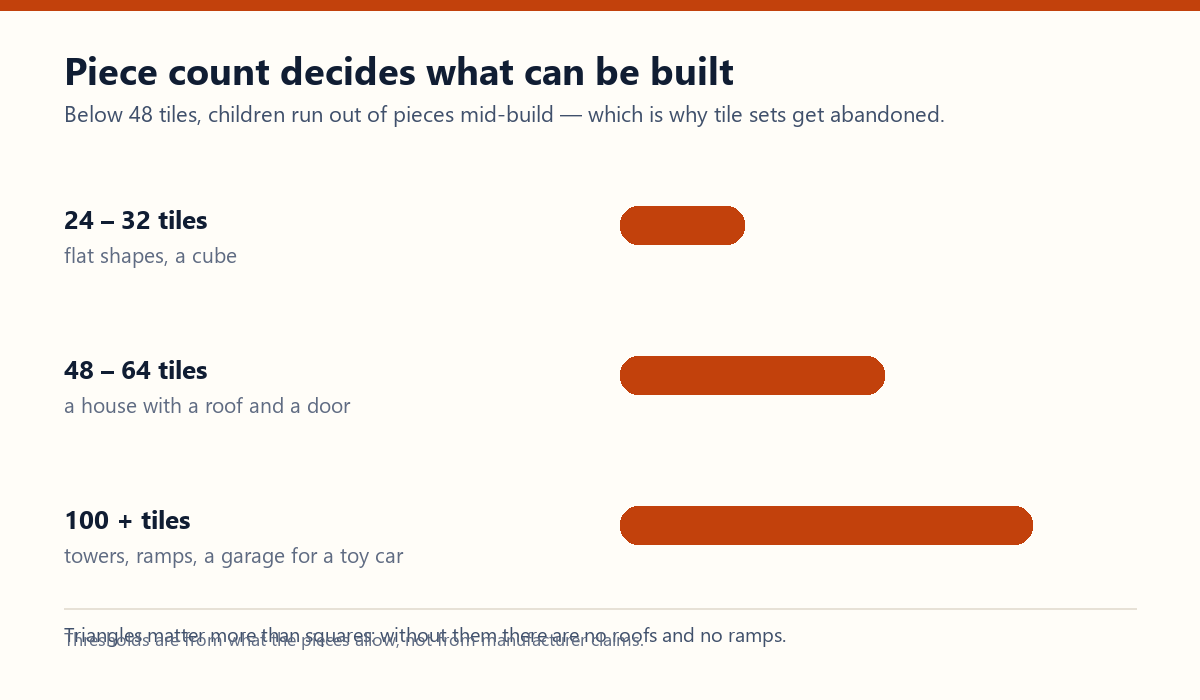
Piece count decides what can be built
Ignore the box photo. These are the real thresholds:
- 24–32 tiles — flat shapes and a cube. Right for two- and three-year-olds.
- 48–64 tiles — a house with a roof and a door. This is the size most families should start with.
- 100+ tiles — towers, ramps, a garage that a toy car can drive into.
- Expansion packs beat a second full set once you own 60+: add windows, wheels or a base plate rather than another pile of squares.
What to buy, in the order most families need it
Same product type at different sizes; the entry is chosen by what the child will build this month, not next year.
The starter set that is not too small
A 48–64 piece set with squares and triangles. Triangles are what make roofs and ramps possible; a set of squares only builds boxes. This is the size where a child stops stacking and starts building.
Street price is usually $35–$70. What to check: at least a third of the pieces are triangles, and the magnets do not rattle when shaken
The first set, for a two-year-old
A 24–32 piece set of large squares. At two the game is click-and-pull, not construction. Large squares are easier to align and less frustrating than a mix of shapes.
Street price is usually $25–$45. What to check: the pieces are sealed on all four edges, with no visible seam or crack
The add-on that unlocks height
A base plate or a set of large rectangles. Most towers fall over because the base is four small squares. One base plate fixes the failure that makes children give up on tiles.
Street price is usually $15–$35. What to check: the plate is compatible with the tiles you already own, and the magnet polarity matches
Wheels, windows and the ‘it moves’ upgrade
An expansion pack with wheels or a door. A tile car is the moment tiles stop competing with blocks. Expansion packs cost less than a new set and change what can be built.
Street price is usually $15–$30. What to check: the wheel housing is one moulded piece, not a glued assembly
Storage that keeps the set usable
A shallow bin with a lid. Tiles stored in a deep box become a lucky dip; stored flat in a shallow bin they get used. This is the cheapest upgrade in the list.
Street price is usually $10–$20. What to check: the lid closes without a latch a three-year-old cannot open
The set to avoid
Very cheap high-count sets (150+ pieces under $40). Price per tile that low usually means weaker magnets and thinner plastic. Weak magnets are the reason children abandon tiles: pieces fall apart mid-build.
Street price is usually —. What to check: if a 100-piece set is under $40, test one joint in the shop before buying
What each budget actually buys
| Budget | What it buys | What to skip |
|---|---|---|
| Under $30 | A 24–32 piece starter, a storage bin | High-count budget sets with weak magnets |
| $30–$70 | A 48–64 piece set with triangles | Two small sets instead of one usable size |
| $70–$120 | A 100+ set, or 60 pieces plus wheels and a base plate | Sets with glued wheel assemblies |
The safety checks we apply
Magnetic toys carry a specific risk that other building toys do not, plus the usual small-part rule:
- Two swallowed magnets are a medical emergency. They attract across the bowel wall; this is why magnetic toys are treated as their own risk category, not as a choking risk.
- Bin any tile with a crack. A cracked tile exposes the magnet. Do not glue it, do not keep it ‘for the big pieces’ — throw it away.
- Age grading is usually 3+. Below that, the pieces are both a small-part and a magnet risk.
- Check the brand against recalls. Magnetic toy recalls are searchable in the CPSC database; the underlying test standard is ASTM F963.
Questions parents ask
Are magnetic tiles worth it, or do blocks do the same job?
They do different jobs. Blocks stack and fall; tiles hold a shape, which lets a child build a roof or a box. Most families end up with both, and the tiles get used longer.
How many pieces do we actually need?
Sixty is the practical floor for building anything with a roof. Below that, children run out of pieces mid-build and stop.
Can a three-year-old use them alone?
Yes, with a 3+ graded set and no cracked pieces. The failure mode at three is frustration, not injury — start with large squares rather than a mixed-shape set.
More by interest: the interest index groups every guide the same way. Shopping by age instead? Start at gifts by age. For how picks are made and how this site earns money, see how we choose gifts.