Wooden Toys for Toddlers: What to Check Before You Buy
Wooden toys last decades or splinter in a month, and the difference is visible in the shop. Here is what to check on the finish, the joints and the paint.
How we make money: some links on this page are affiliate links. If you buy through them we may earn a commission at no extra cost to you. Our picks and rankings are not paid placements.
How we picked
- We only publish a guide when there is a real shortlist behind it. If we cannot justify a pick in one sentence, it does not go in.
- Every pick is checked against the age grading the manufacturer states and the current US recall list before it is listed.
- Prices are checked against at least two retailers. If a pick is out of stock we say so instead of quietly leaving a dead link.
- No brand can pay for a position. Commission never decides what is recommended or where it ranks.
The reason to buy wooden toys is not nostalgia: wood is repairable, it does not hide cracks, and it survives being stood on. The reason wooden toys disappoint is that “wooden” says nothing about the finish, the joints or the paint.
So this guide is a set of checks rather than a list of brands. You can run all of them in a shop in two minutes, with the toy in your hand.
Five checks, in the order they matter
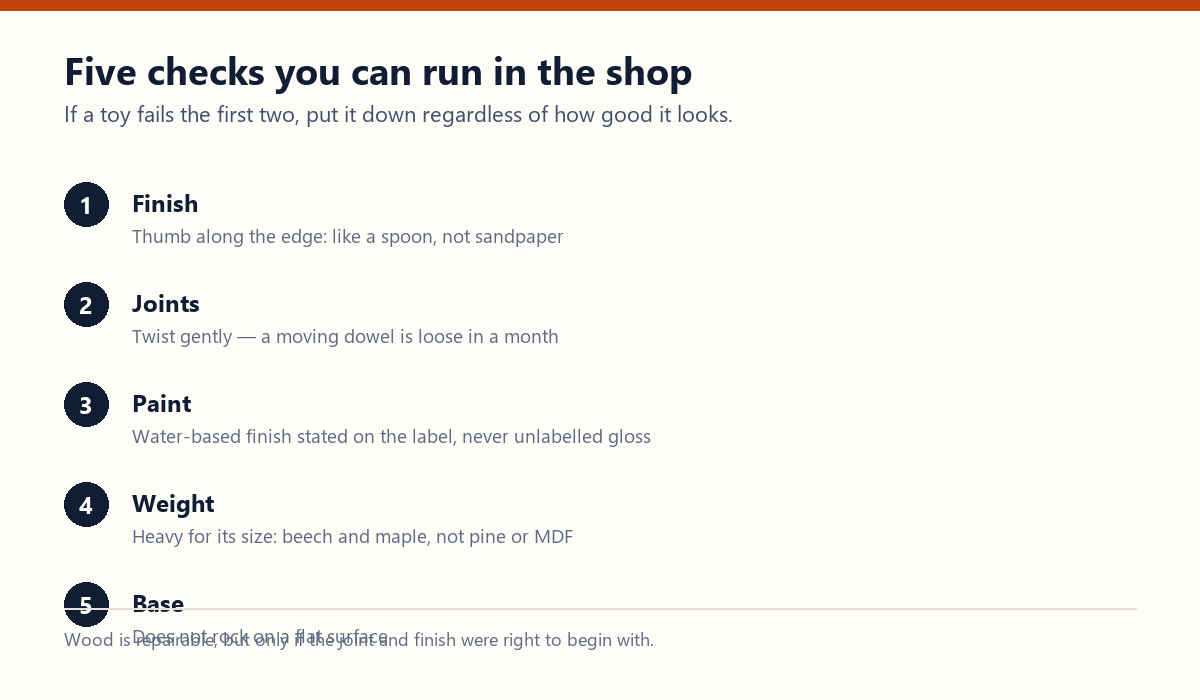
If a toy fails the first two, put it down regardless of how good it looks:
- The finish. Run a thumb along an edge: it should feel like a spoon, not like sandpaper. Visible raised grain means it will splinter.
- The joints. Twist gently. A dowel joint that moves now will be loose in a month; a screwed or glued joint should not shift at all.
- The paint. It should be a water-based finish stated on the label, not an unlabelled gloss. Cheaper gloss chips, and chips go into mouths.
- The weight. Solid beech and maple are heavy for their size; pine and MDF-filled toys are light and dent.
- The base. A stacking toy that rocks on a flat surface will frustrate a toddler more than it entertains them.
Six wooden buys that earn their price
Types rather than brands: these are the shapes that get used for years rather than weeks.
The one that gets played with at every age
A set of plain wooden blocks, 40–60 pieces. No theme, no right answer, no battery. This is the toy that becomes a garage at three and a castle at six, and it is the cheapest per hour of use of anything in this guide.
Street price is usually $30–$60. What to check: sanded edges, pieces at least 4 cm so they clear a choke tube, and a cloth bag rather than a moulded tray
The first puzzle that is not a board
A chunky wooden puzzle with knobs, 4–9 pieces. Knob puzzles are the bridge between posting and real puzzles: the knob gives a fist something to hold, and the picture underneath makes it solvable alone.
Street price is usually $12–$25. What to check: the knobs are screwed or glued through the piece, not surface-mounted, and the paint is water-based
The pull-along that does not fall over
A weighted pull-along toy with a short string. Most pull-alongs tip the moment a toddler turns. A low centre of gravity and a short string keep it upright, which is the whole game.
Street price is usually $20–$40. What to check: the string is under 22 cm so it cannot go around a neck, and the wheels turn on metal axles
The stacking toy that teaches size order
A wooden ring stacker with a tapered post. A tapered post means the rings only fit in one order, which is what teaches size comparison. A straight post lets a child put them on in any order and learn nothing.
Street price is usually $15–$30. What to check: the base is wider than the tallest tower is high, so it cannot be pulled over
The open-ended set that grows
A wooden train set with a basic track loop. Train track is the earliest engineering kit: the child builds the path, then runs something along it. Start with a loop and a bridge rather than a 100-piece set.
Street price is usually $40–$80. What to check: the connectors are compatible with the common wooden rail standard, so the set can grow
What to skip
Decorative wooden toys with painted details. The rule is simple: if the paint is raised, glossy or unlabelled, it will chip. Decorative toys are for shelves, not for a toddler who mouths everything.
Street price is usually —. What to check: if the label does not state the finish, assume it is not mouth-safe
What each budget actually buys
| Budget | What it buys | What to skip |
|---|---|---|
| Under $25 | A knob puzzle, a ring stacker | Painted decorative pieces |
| $25–$60 | Plain blocks, a pull-along, a small rail set | Large themed sets the child cannot build alone |
| $60–$100 | A 100-piece block set, a train set with a bridge | Imported sets with no finish statement |
The safety checks we apply
Wood is a natural material, which means it fails differently from plastic — and some of those failures are sharp:
- Check for splinters along every edge, not just the ones a child is likely to touch. Splinters appear where the grain is raised.
- Chipped paint is a swallowing risk. Retire any piece where the finish is lifting; do not sand and repaint it yourself unless you use a child-safe finish.
- Strings, cords and straps should be under 22 cm, on pull-alongs and toy phones alike.
- Check recalls before buying second-hand in the CPSC database; wooden toys sold as toys fall under ASTM F963.
- Age grading still applies. The AAP’s preschool guidance covers what a three-year-old can safely handle.
Questions parents ask
Is wooden always better than plastic?
No. Wood is better when it is solid, well-jointed and repairable; it is worse when it is thin, painted with an unlabelled gloss, or shaped into details that snap. The material is not the guarantee, the construction is.
Beeswax or lacquer?
Beeswax and oil finishes feel better and are safe if the child mouths the toy, but they need re-oiling. Lacquer is tougher but must be a stated water-based product. Unlabelled gloss is the one to avoid.
How do I clean wooden toys?
Damp cloth with mild soap, then dry immediately. Do not soak them and do not put them in a dishwasher — water swells the grain and loosens joints.
More by interest: the interest index groups every guide the same way. Shopping by age instead? Start at gifts by age. For how picks are made and how this site earns money, see how we choose gifts.