Sensory Toys for Kids: What Each Type Actually Does
Sensory toys are sold as a category but they work on different systems — touch, movement, pressure, sound. Buying the wrong one is why they end up unused.
How we make money: some links on this page are affiliate links. If you buy through them we may earn a commission at no extra cost to you. Our picks and rankings are not paid placements.
How we picked
- We only publish a guide when there is a real shortlist behind it. If we cannot justify a pick in one sentence, it does not go in.
- Every pick is checked against the age grading the manufacturer states and the current US recall list before it is listed.
- Prices are checked against at least two retailers. If a pick is out of stock we say so instead of quietly leaving a dead link.
- No brand can pay for a position. Commission never decides what is recommended or where it ranks.
“Sensory toy” is a marketing category, not a functional one. A weighted blanket, a fidget spinner and a sensory bin are sold together and do completely different things: one gives deep pressure, one gives something to do with the hands, one gives a texture to explore.
This guide sorts them by which sense they work on, so you can buy for the child in front of you rather than for the label.
Match the toy to the system, not the label
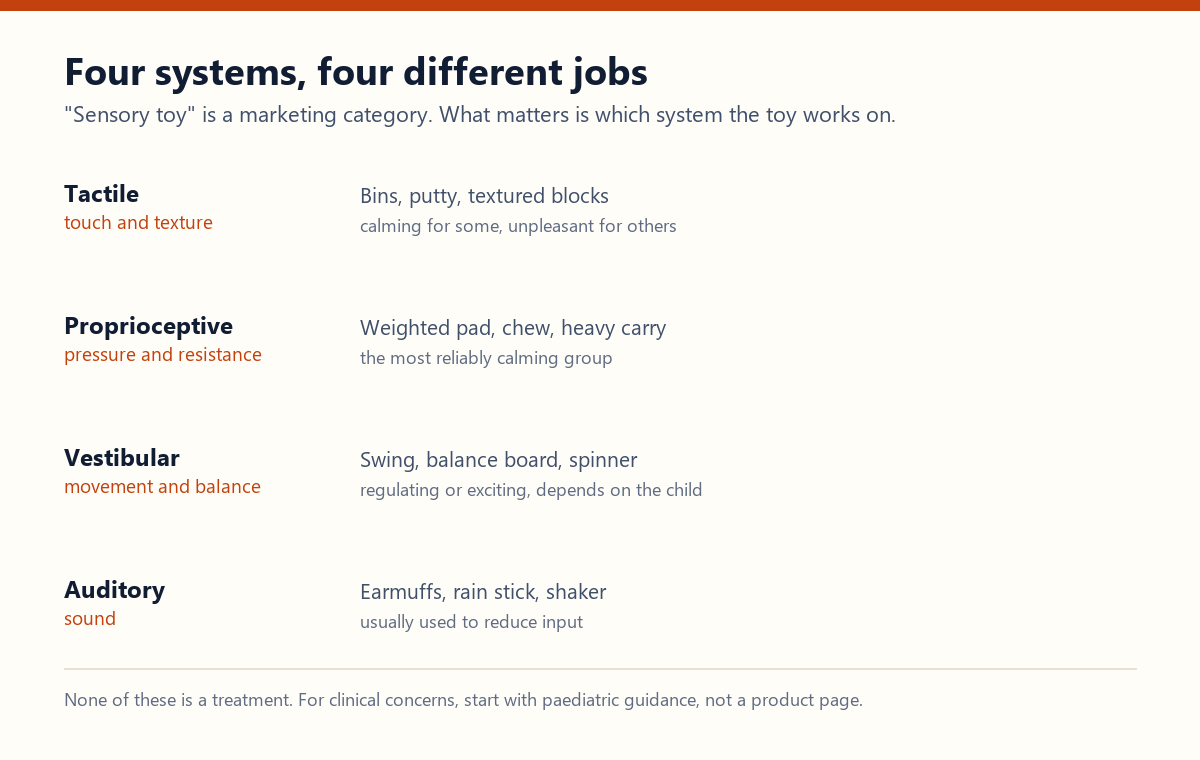
Four systems cover most of what is sold as sensory play:
- Tactile (touch) — bins, textured blocks, putty. Calming for some children, actively unpleasant for others.
- Proprioceptive (pressure and resistance) — weighted items, chews, heavy carry toys. Usually the most reliably calming group.
- Vestibular (movement) — swings, balance boards, spinners. Either regulating or exciting, depending on the child.
- Auditory (sound) — headphones, rain sticks, quiet shakers. Mostly used to reduce input rather than add it.
Six types, and who each one suits
None of these is a treatment. They are tools for a child who is already being supported; if there is a clinical concern, the toy is not the answer.
The one that works for almost everyone
A weighted lap pad or cushion, 5–10% of body weight. Deep pressure is the most reliable regulating input, and a lap pad is easier to use than a blanket because the child can put it on and take it off themselves.
Street price is usually $30–$60. What to check: the weight is stated in pounds, the cover is washable, and the filling is sewn into channels so it does not bunch
Something to do with the hands that is not a screen
Theraputty or a firm putty, medium resistance. Putty gives resistance, which is what most fidget toys lack. It also hides small objects inside for a finding game, which extends the use past the first week.
Street price is usually $10–$20. What to check: it is labelled non-toxic and does not leave residue on fabric
The bin that gets used for an hour
A sensory bin with a lid, plus two fillers. The bin is the toy; the filler is consumable. A lid means the activity can be paused instead of abandoned, which is what makes it reusable.
Street price is usually $25–$50. What to check: the filler is too large to swallow if there is a child under three in the house
For the child who cannot sit still at the table
A balance board or a wobble cushion. Movement while sitting is often what lets a child stay at the table at all. A wobble cushion is the cheaper, quieter version.
Street price is usually $25–$70. What to check: the board holds the child’s weight without flexing, and the cushion has a textured base
For the child who is overwhelmed by noise
Over-ear earmuffs rated for children, NRR 22 or higher. Reducing input is more effective than adding a calming toy for a child in a noisy room. Earmuffs are the intervention; the fidget is the follow-up.
Street price is usually $15–$30. What to check: the headband adjusts small enough for a four-year-old, and the cups seal without clamping
What to avoid
Chew jewellery sold without a safety statement. Chewables are the one sensory product with a real hazard: a torn piece is a choking risk. Buy from a seller who states the material and the breakaway clasp.
Street price is usually —. What to check: the seller states BPA-free, food-grade silicone and a breakaway clasp, and replaces it at the first tear
What each budget actually buys
| Budget | What it buys | What to skip |
|---|---|---|
| Under $25 | Putty, a small bin, earmuffs | Chewables without a material statement |
| $25–$60 | A weighted lap pad, a wobble cushion, a lidded bin | Weighted blankets for a child who will not keep them on |
| $60–$100 | A balance board, or a swing with a proper mount | Equipment that needs ceiling mounting without an installer |
The safety checks we apply
Sensory products sit in a gap: many are sold as ‘therapeutic’ rather than as toys, which means less automatic safety testing. Check these yourself:
- Weighted products need the weight stated and sewn into channels. Loose filling can shift and concentrate; a child should be able to remove it without help.
- Never use a weighted product on a child who cannot remove it themselves, and never in a cot.
- Fillers are a choking risk. Rice, beads and water beads are all small enough to swallow; water beads are the ones that expand internally and are the most dangerous.
- If a product is sold as a toy it falls under ASTM F963; recalls are searchable in the CPSC database.
- This is not a treatment. For concerns about sensory processing, the AAP’s guidance on toddler development is the place to start, not a product page.
Questions parents ask
Do sensory toys help with autism or ADHD?
They can help a child regulate in a specific moment; they are not a treatment for either. The evidence supports environmental and behavioural support, with sensory tools as one small part.
Which one should I buy first?
A weighted lap pad, because deep pressure is the most reliable input and it is easy for a child to self-manage. Buy one thing and watch what the child does with it before buying more.
Are water beads safe?
Not for children who mouth objects. Swallowed water beads absorb fluid and expand inside the body, which is why several countries have restricted their sale to older children.
More by interest: the interest index groups every guide the same way. Shopping by age instead? Start at gifts by age. For how picks are made and how this site earns money, see how we choose gifts.