LEGO Sets for Kids: Which Range Fits Which Age
Duplo, Classic, City and Technic are not difficulty levels — they are different part sizes and different ages. Here is how to pick the right range without guessing from the box.
How we make money: some links on this page are affiliate links. If you buy through them we may earn a commission at no extra cost to you. Our picks and rankings are not paid placements.
How we picked
- We only publish a guide when there is a real shortlist behind it. If we cannot justify a pick in one sentence, it does not go in.
- Every pick is checked against the age grading the manufacturer states and the current US recall list before it is listed.
- Prices are checked against at least two retailers. If a pick is out of stock we say so instead of quietly leaving a dead link.
- No brand can pay for a position. Commission never decides what is recommended or where it ranks.
Most LEGO buying mistakes happen before the child opens the box: an adult buys the set that looks impressive rather than the range that matches the child’s hands. The box tells you which is which, but only if you know what the label is actually grading.
This guide is about ranges rather than specific set numbers. Ranges stay stable for years; set numbers rotate every season, so a guide that lists them is out of date by the time it ranks.
First, read the range, not the picture
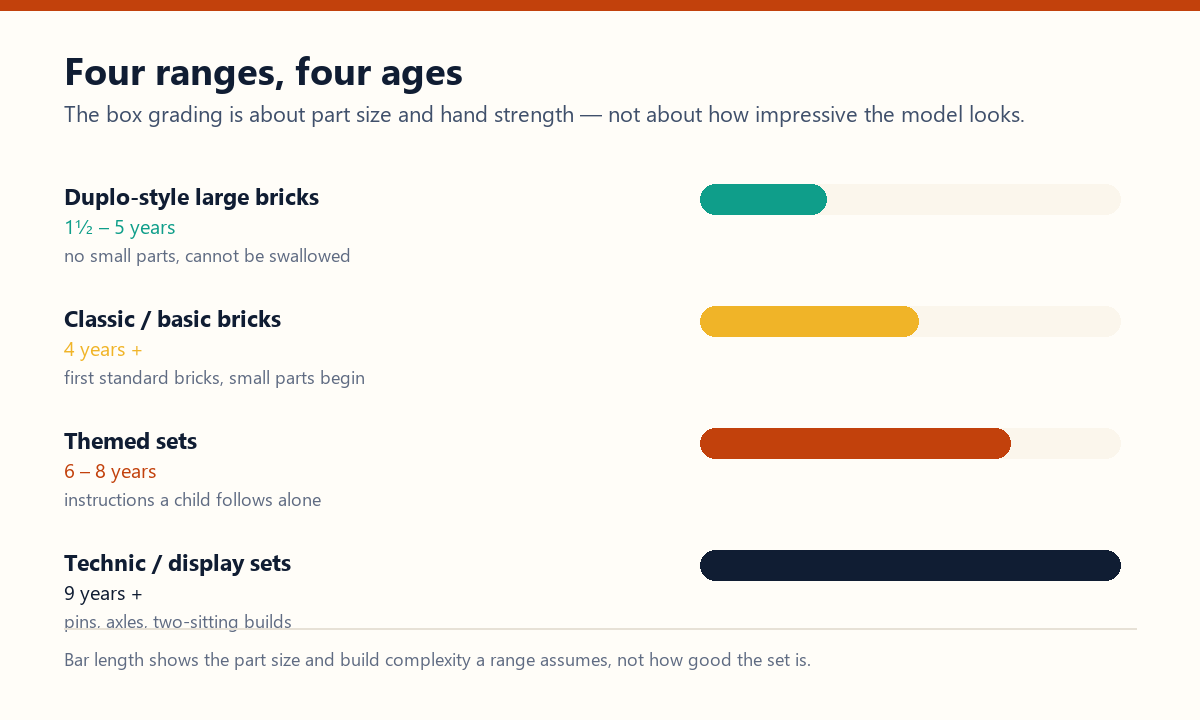
The four ranges you will meet, and what each one is actually for:
- Duplo-style large bricks — graded 1½+, designed so a toddler cannot swallow a brick and cannot jam two pieces permanently.
- Classic / basic brick boxes — usually 4+, the first standard-size bricks. This is the range where “small parts” starts to matter.
- Themed sets (City, Friends, Ninjago and similar) — 6+ to 8+, built around instructions a child follows alone.
- Technic and large display sets — 9+ and up: pins, axles, sub-assemblies, and a genuine two-sitting build.
Six buys that actually get built
Each entry is a type of purchase rather than a product. The right one depends on the child’s age and whether they build alone.
The first box, for a child under three
A Duplo-style starter box, 40–80 pieces. Large bricks are the only version a two-year-old can press together and pull apart without help. Buy fewer pieces than you think: a small box gets fully used.
Street price is usually $25–$50. What to check: the box states 1½+ or 2+, and the pieces are at least 3 cm on a side
The jump to real bricks
A Classic-style basic box, 300–500 pieces. This is the set that outlives every themed set, because it has no single right answer. It is also the cheapest way to find out whether a child actually likes building.
Street price is usually $30–$60. What to check: graded 4+, pieces sorted by colour in bags, and a small idea booklet rather than one model
A child who wants to follow instructions alone
One themed set at their exact grade, 200–400 pieces. Six- and seven-year-olds want to finish something without an adult reading the steps. Size the set so it can be finished in one sitting, or it becomes a table ornament.
Street price is usually $40–$80. What to check: graded 6+ or 7+, numbered bags, and a model that does not need an adult for step one
The sibling problem
A second small set at the younger child’s grade. The most common failure in a house with two children is one set graded 9+ and a five-year-old who wants to join in. A cheap small set at the younger grade prevents most of it.
Street price is usually $15–$30. What to check: graded for the younger child, and no pieces small enough to disappear into a mouth
Storage that survives being tipped out
A shallow sorting tray or a brick mat. Sets get rebuilt when the pieces are findable. A mat that turns into a bag cuts rebuild time from twenty minutes to two, which is the difference between a hobby and a shelf.
Street price is usually $15–$35. What to check: the fabric is washable and the corners have grommets rather than loose cord
The upgrade that is not a bigger box
One Technic-style set, at 9+ or above. If a child has built everything in the 6+ range, the next step is a mechanism, not volume. Pins and axles teach how things move; another 800 basic bricks does not.
Street price is usually $50–$120. What to check: graded 9+ or 10+, and the child has finished at least one 7+ set alone
What each budget actually buys
| Budget | What it buys | What to skip |
|---|---|---|
| Under $30 | A small Duplo or Classic box, a sorting mat | Giant themed sets bought ‘to grow into’ |
| $30–$80 | A 300–500 piece basic box, one themed set at grade | Two mid-size sets instead of one that gets finished |
| $80–$120 | A Technic-style set for a child who already builds alone | Display sets graded 18+ for a primary-school child |
The safety checks we apply
Bricks are a choking hazard below the stated age, and a foot hazard above it. Three checks that matter more than the rest:
- The grade is about part size. A 6+ set in a house with a two-year-old needs to live somewhere the two-year-old cannot reach.
- Small loose parts travel. Minifigure accessories are the pieces that end up in mouths and vacuum cleaners; count them out of the box if there is a younger sibling.
- Check recalls by set number, not by brand: the CPSC recall database is searchable, and brick sets are recalled occasionally for detachable parts.
- Toy safety testing follows ASTM F963, which is what the age grading on the box refers to.
Questions parents ask
Is Duplo worth it if we already have standard bricks?
For a child under three, yes — standard bricks are too small to be safe and too stiff for small hands. Most families get two to three years of use before moving up.
Should I buy the set the child asks for, or the one that fits?
Both, if the requested set is within one grade of the child’s age. If it is two grades up, buy a small set at their grade instead and let them build up to it.
Do I need the app?
No. Paper instructions still work, and the printed booklet is usually easier for a six-year-old to follow alone than a screen that keeps scrolling.
More by interest: the interest index groups every guide the same way. Shopping by age instead? Start at gifts by age. For how picks are made and how this site earns money, see how we choose gifts.